MY SEARCH ENGINE

Wednesday, May 16, 2018

JPL News - Day in Review


DAY IN REVIEW
Science Launching to Space Station Looks Forward and Back
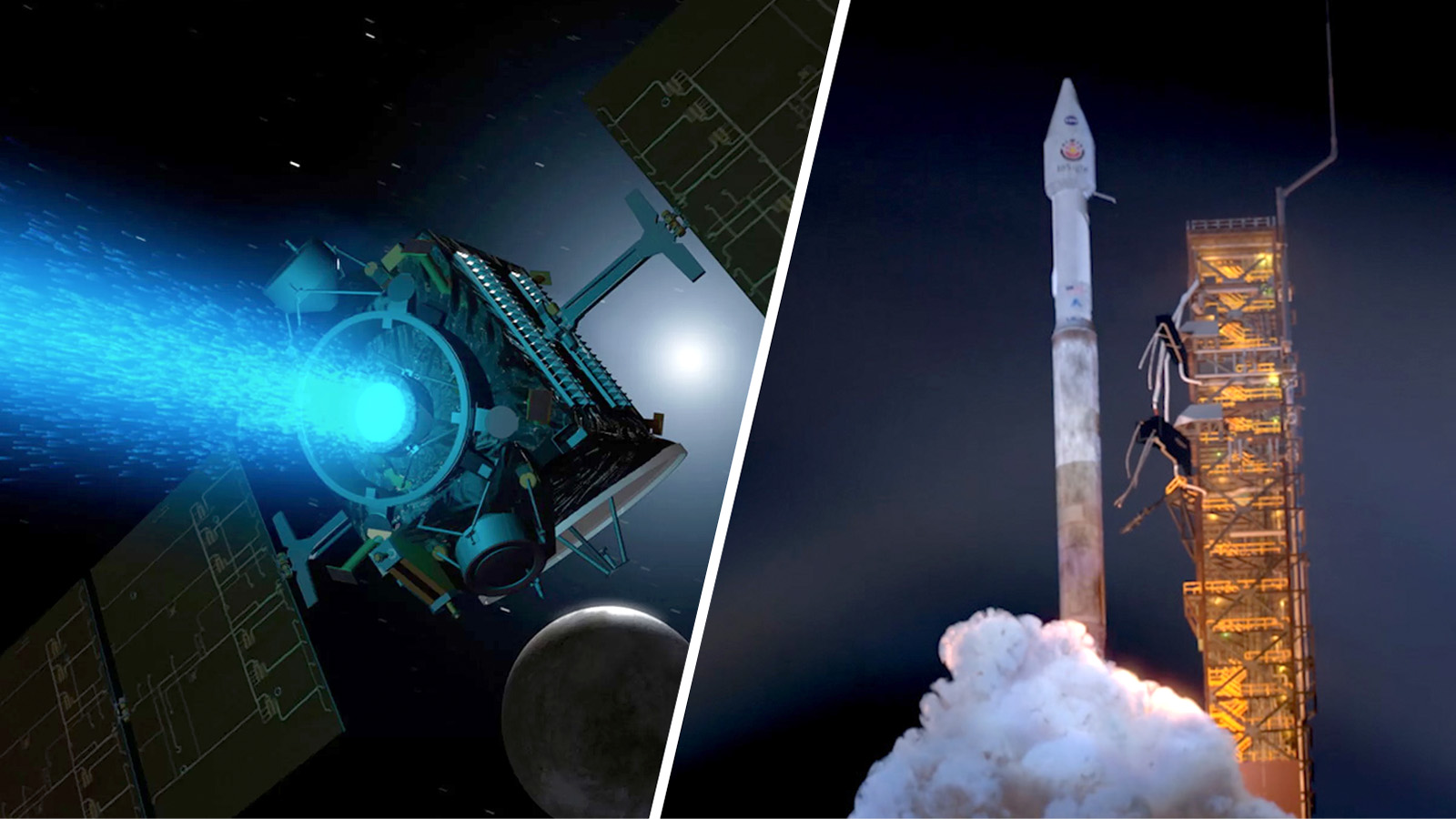
The Cold Atom Laboratory, from JPL, is one science payload launching to the International Space Station aboard an Orbital ATK Cygnus spacecraft no earlier than May 20.
› Read the full story
NASA Satellites Reveal Major Shifts in Global Freshwater
Scientists have combined NASA Earth satellite observations with data on human activities to map locations where freshwater is changing around the globe and to determine why.
› Read the full story
Update: Launch Coverage of Earth-Observing Satellites
Revised dates have been set for the prelaunch briefing and launch of GRACE-FO, NASA's latest Earth-observing satellite mission.
› Read the full story


Tuesday, May 15, 2018

JPL News - Day in Review


DAY IN REVIEW
NASA JPL latest news release
A Pale Blue Dot, As Seen by a CubeSat

NASA's Voyager 1 took a classic portrait of Earth from several billion miles away in 1990. Now a class of tiny, boxy spacecraft, known as CubeSats, have just taken their own version of a "pale blue dot" image, capturing Earth and its moon in one shot.

NASA set a new distance record for CubeSats on May 8 when a pair of CubeSats called Mars Cube One (MarCO) reached 621,371 miles (1 million kilometers) from Earth. One of the CubeSats, called MarCO-B (and affectionately known as "Wall-E" to the MarCO team) used a fisheye camera to snap its first photo on May 9. That photo is part of the process used by the engineering team to confirm the spacecraft's high-gain antenna has properly unfolded.

As a bonus, it captured Earth and its moon as tiny specks floating in space.

"Consider it our homage to Voyager," said Andy Klesh, MarCO's chief engineer at NASA's Jet Propulsion Laboratory, Pasadena, California. JPL built the CubeSats and leads the MarCO mission. "CubeSats have never gone this far into space before, so it's a big milestone. Both our CubeSats are healthy and functioning properly. We're looking forward to seeing them travel even farther."

The MarCO spacecraft are the first CubeSats ever launched to deep space. Most never go beyond Earth orbit; they generally stay below 497 miles (800 kilometers) above the planet. Though they were originally developed to teach university students about satellites, CubeSats are now a major commercial technology, providing data on everything from shipping routes to environmental changes.

The MarCO CubeSats were launched on May 5 along with NASA's InSight lander, a spacecraft that will touch down on Mars and study the planet's deep interior for the first time. InSight, short for Interior Exploration using Seismic Investigations, Geodesy and Heat Transport, will attempt to land on Mars on Nov. 26. JPL also leads the InSight mission.

Mars landings are notoriously challenging due to the Red Planet's thin atmosphere. The MarCO CubeSats will follow along behind InSight during its cruise to Mars. Should they make it all the way to Mars, they will radio back data about InSight while it enters the atmosphere and descends to the planet's surface. The high-gain antennas are key to that effort; the MarCO team have early confirmation that the antennas have successfully deployed, but will continue to test them in the weeks ahead.

InSight won't rely on the MarCO mission for data relay. That job will fall to NASA's Mars Reconnaissance Orbiter. But the MarCOs could be a pathfinder so that future missions can "bring their own relay" to Mars. They could also demonstrate a number of experimental technologies, including their antennas, radios and propulsion systems, which will allow CubeSats to collect science in the future.

Later this month, the MarCOs will attempt the first trajectory correction maneuvers ever performed by CubeSats. This maneuver lets them steer towards Mars, blazing a trail for CubeSats to come.

For more information about MarCO, visit:

https://www.jpl.nasa.gov/cubesat/missions/marco.php


Monday, May 14, 2018

JPL News - Day in Review


DAY IN REVIEW
Old Data Reveal New Evidence of Europa Plumes
Scientists re-examining data from an old mission bring new insights to the tantalizing question of whether Jupiter's moon Europa has the ingredients to support life.
› Read the full story
GRACE-FO Will Help Monitor Droughts
You may not notice water in the ground under your feet, but it plays an important role in keeping you alive.
› Read the full story


Friday, May 11, 2018

JPL News - Day in Review


DAY IN REVIEW
NASA Hosts Live Discussion about Europa Findings, Potential for Life
NASA will host a Science Chat May 14 about the latest analysis of Jupiter's moon Europa and its status as a promising place in the solar system to search for life.
› Read the full story
NASA Television to Air Coverage of Earth-Observing Satellite Duo Launch
Media are invited to cover the prelaunch briefing and launch of the Gravity Recovery and Climate Experiment Follow-On (GRACE-FO), NASA's latest Earth-observing satellite mission.
› Read the full story
Mars Helicopter to Fly on NASA's Next Red Planet Rover Mission
NASA is adding a Mars helicopter to the agency's next mission to the Red Planet, Mars 2020.
› Read the full story


Monday, May 7, 2018

JPL News - Day in Review


DAY IN REVIEW
NASA Highlights Science on Next Orbital ATK Mission to Space Station
NASA will host a May 10 media telecon about select science investigations and tech demonstrations on the next Orbital ATK commercial flight to the International Space Station.
› Read the full story
NASA Satellite detects Kilauea Fissures
The eruption of Kilauea Volcano on the island of Hawaii triggered a number of gas- and lava-oozing fissures in the East Riff Zone of the volcano.
› Read the full story


Saturday, May 5, 2018

JPL News - Day in Review


DAY IN REVIEW
NASA, ULA Launch Mission to Study How Mars Was Made
NASA's Mars InSight mission launched this morning on a 300-million-mile trip to Mars to study for the first time what lies deep beneath the surface of the Red Planet.
› Read the full story
NASA's First Deep-Space CubeSats Say: 'Polo!'
MarCO is a pair of tiny spacecraft that launched with NASA's InSight lander today.
› Read the full story


NASA's First Deep-Space CubeSats Say: 'Polo!'


LATEST NEWS
NASA JPL latest news release
NASA's First Deep-Space CubeSats Say: 'Polo!'

NASA has received radio signals indicating that the first-ever CubeSats headed to deep space are alive and well. The first signal was received at 12:15 p.m. PST (3:15 p.m. EST) today; the second at 1:58 p.m. PST (4:58 p.m. EST). Engineers will now be performing a series of checks before both CubeSats enter their cruise to deep space.

Mars Cube One, or MarCO, is a pair of briefcase-sized spacecraft that launched along with NASA's InSight Mars lander at 4:05 a.m. PDT (7:05 a.m. EDT) today from Vandenberg Air Force Base in Central California. InSight is a scientific mission that will probe the Red Planet's deep interior for the first time; the name stands for Interior Exploration using Seismic Investigations, Geodesy and Heat Transport.

The twin MarCO CubeSats are on their own separate mission: rather than collecting science, they will follow the InSight lander on its cruise to Mars, testing out miniature spacecraft technology along the way.

Both were programmed to unfold their solar panels soon after launch, followed by several opportunities to radio back their health.

"Both MarCO-A and B say 'Polo!' It's a sign that the little sats are alive and well," said Andy Klesh, chief engineer for the MarCO mission at NASA's Jet Propulsion Laboratory in Pasadena, California, which built the twin spacecraft.

The computers inside each MarCO CubeSat haven't been turned on since being tested at California Polytechnic State University, San Luis Obispo, in mid-March, where they were prepared for launch by Tyvak Nano-Satellite Systems of Irvine, California. Each spacecraft had to do a lot of things right by itself for the team to hear a signal: batteries had to retain enough charge for the spacecraft to deploy their solar arrays, stabilize their attitude, turn toward the Sun and turn on their radios.

A couple of weeks will be spent assessing how the MarCO CubeSats are performing. If they survive the radiation of space and function as planned, they'll fly over the Red Planet during InSight's entry, descent and landing in November. They each have a special antenna to relay InSight's vital signs during the infamous "Seven Minutes of Terror," the crucial phase which has claimed the majority of humanity's probes sent to land on the Red Planet.

CubeSats are a kind of boxy satellite invented to teach engineering students how to build spacecraft. Today, they offer access to space for private companies and research institutions. They're just one kind of "SmallSat," which includes a broad range organized by weight class. CubeSats are generally under 33 pounds (15 kilograms), and can weigh as little as about five pounds (2.5 kilograms). They're distinctively modular, which makes it easier to buy "plug-in" parts rather than custom-design every part of the spacecraft.

NASA is taking the opportunity to test several experimental systems with MarCO. Their radios, folding high-gain antennas, attitude control and propulsion systems are all included to prove new technologies in deep space.

"We're nervous but excited," said Joel Krajewski of JPL, MarCO's project manager. "A lot of work went into designing and testing these components so that they could survive the trip to Mars and relay data during InSight's landing. But our broader goal is to learn more about how to adapt CubeSat technologies for future deep-space missions."

When InSight arrives on Mars in November, it won't rely on MarCO for sending landing data back to Earth. That job will go to NASA's Mars Reconnaissance Orbiter, as well as several Earth-based astronomy telescopes. But the MarCO mission could help prove the potential for CubeSats as a kind of bring-your-own "black box" for future NASA missions.

MarCO was built by JPL, which manages InSight and MarCO for NASA. It was funded by both JPL and NASA's Science Mission Directorate. A number of commercial suppliers provided unique technologies for MarCO. A full list, along with more information about the spacecraft, can be found here.


Thursday, May 3, 2018

JPL News - Day in Review


DAY IN REVIEW
NASA JPL latest news release
NASA's First Mission to Study the Interior of Mars Awaits May 5 Launch

All systems are go for NASA's next launch to the Red Planet.

The early-morning liftoff on Saturday of the Mars InSight lander will mark the first time in history an interplanetary launch will originate from the West Coast. InSight will launch from the U.S. Air Force Vandenberg Air Force Base Space Launch Complex 3E. The two-hour launch window will open on May 5 at 4:05 a.m. PDT (7:05 a.m. EDT).

InSight, for Interior Exploration using Seismic Investigations, Geodesy and Heat Transport, will launch aboard aUnited Launch Alliance (ULA) Atlas V rocket. InSight will study the deep interior of Mars to learn how all rocky planets formed, including Earth and its Moon. The lander's instruments include a seismometer to detect marsquakes, and a probe that will monitor the flow of heat from the planet's interior.

The ULA rocket will carry the spacecraft over the Channel Islands just off the California Coast and continue climbing out over the Pacific, shadowing the coastline south beyond Baja California. InSight's Atlas will reach orbit about 13 minutes after launch, when the rocket is about 1,200 miles (1,900 kilometers) northwest of Isabella Island, Ecuador.

"For those Southern Californians who are interested in rockets or space exploration, or have insomnia, we hope to put on a great show this Saturday," said Tom Hoffman, InSight project manager from NASA's Jet Propulsion Laboratory in Pasadena, California. "But for those who want to sleep in on Saturday, there will be another opportunity to engage with this historic mission. We will be landing on Mars in the western Elysium Planitia region on Monday, Nov. 26, around noon Pacific time. You will be able to watch a live stream of this landing while working on your holiday shopping."

Getting a Mars mission flying requires a great many milestones. Among those still to come are the official start of the countdown to launch -- which comes on Friday, May 4 at 10:14 a.m. PDT (Saturday, May 5, 1:14 a.m. EDT). A little over an hour later, at about 11:30 p.m. PDT (May 5, 2:30 a.m. EDT), the 260-foot-tall (80-meter) Mobile Service Tower -- a structure that has been protecting the Atlas V launch vehicle and its InSight payload during their vertical assembly -- will begin a 20-minute long, 250-foot (about 80-meter) roll away from the Atlas. Four hours and 25 minutes later, the launch window will open.

"I've been to several rocket launches, but it is a whole different vibe when there is something you've been working on for years sitting in the nose cone waiting to get hurled beyond our atmosphere," said Bruce Banerdt, InSight principal investigator at JPL. "But as exciting as launch day will be, it's just a first step in a journey that should tell us not only why Mars formed the way it did, but how planets take shape in general."

InSight's launch period is May 5 through June 8, 2018, with multiple launch opportunities over windows of approximately two hours each date. Launch opportunities are set five minutes apart during each date's window.Whichever date the launch occurs, InSight's landing on Mars is planned for Nov. 26, 2018, around noon PST (3 p.m. EST).

JPL manages InSight for NASA's Science Mission Directorate. InSight is part of NASA's Discovery Program, managed by the agency's Marshall Space Flight Center in Huntsville, Alabama. The InSight spacecraft, including cruise stage and lander, was built and tested by Lockheed Martin Space in Denver. NASA's Launch Services Program at the agency's Kennedy Space Center in Florida provides launch management. United Launch Alliance of Centennial, Colorado, is NASA's launch service provider of the Atlas 5 rocket. A number of European partners, including France's Centre National d'Études Spatiales (CNES) and the German Aerospace Center (DLR), are supporting the InSight mission.In particular, CNES provided the Seismic Experiment for Interior Structure (SEIS) instrument, with significant contributions from the Max Planck Institute for Solar Systems Research (MPS). DLR provided the Heat Flow and Physical Properties Package (HP3) instrument.

For more information about InSight, visit:

https://mars.nasa.gov/insight/

Live televised coverage of the launch will be available at:

https://www.nasa.gov/live

For information on viewing the launch in person, visit:

https://mars.nasa.gov/insight/mission/timeline/launch/watch-in-person/


Fri & Sat: A NASA/JPL Edu Teachable Moment Twofer

NASA/JPL Edu Teachable Moments
 

This Week's Teachable Moment Twofer

The next couple days are full of opportunities to turn space exploration events into teachable moments for students. Make it happen with these resources and activities from the Education Office at NASA's Jet Propulsion Laboratory.

First up is Star Wars Day on Friday, May 4. (Or as fans like to say, "May the fourth be with you.") While the movies are science fiction, they do feature some very real technology that's been used to propel NASA spacecraft to other worlds – and it makes for a great high-school lesson in Newton's Laws. It's also the perfect time to awaken students in all grades to lessons in forces and motion. Explore the links below to get started.

  • Teachable Moment: Here's how to turn a Star Wars staple into a real-world lesson in Newton's Laws.
  • May the Fourth Lessons: Celebrate Star Wars Day with these standards-aligned lessons in motion and forces for grades K-12.

After learning about forces on May the 4th, students might be able to see them in action the very next day! NASA's next mission to Mars is scheduled to launch as early as 4:05 a.m. on May 5. The Central California liftoff means that viewers across much of the state will likely be able to see the launch from home, but people elsewhere or those with obscured views can also watch it on NASA TV. In addition to the launch, the mission itself, which is designed to reveal Mars' inner workings and provide a window into how other rocky planets formed, offers a host of real-world STEM learning opportunities. Find out more at the links below.

  • Teachable Moment: What is NASA InSight and what can it teach students about STEM?
  • Mars Lessons: Explore a collection of standards-aligned lessons for K-12 all about the Red Planet.


Wednesday, May 2, 2018

JPL News - Day in Review


DAY IN REVIEW
NASA JPL latest news release
GRACE-FO: Cracking a Cold Case

Mission To Study How Melting Polar Ice Affects Regional Sea Levels

Reports of the rapidly melting West Antarctic ice sheet often refer to how much the melting could add to global sea levels -- as if meltwater raises the ocean evenly, like a sink filling up. The reality is far different. Water from West Antarctica will end up raising sea levels more in Los Angeles and Miami than in Rio de Janeiro, for example, even though Brazil is thousands of miles closer to Antarctica than the United States.

How do we know? Scientists first observed this ocean pattern using data from NASA's Gravity Recovery and Climate Experiment (GRACE) satellite mission, which ended last October after 15 years of operation. When the NASA/German Research Centre for Geosciences GRACE Follow-On (GRACE-FO) mission is launched from Vandenberg Air Force Base in Central California next month, it will take up the job of monitoring melting polar ice. That will give scientists a renewed opportunity to understand some of the many processes that lead to different rates of sea level rise on different coastlines. Since runoff from melting ice sheets and glaciers currently accounts for about two-thirds of global sea level rise, understanding these melt-related processes is a critical piece of understanding sea level change at a regional scale.

Fingerprints of Water

The gravitational pull of an ice sheet attracts seawater from the nearby oceans and causes it to pile up along the coastlines. When the ice sheet melts and loses mass, the gravitational pull is reduced, causing the sea level nearby to fall. At the same time, the additional meltwater in the ocean causes sea level rise -- but it rises farther away from the melt source. The falling sea level near the ice sheet and rising sea level farther away are connected like the rising and falling ends of a seesaw. Since every ice sheet and glacier has a unique location and size, each one creates a different seesawing pattern, as individual as a fingerprint.

Scientists had theorized that these fingerprint patterns existed, but only observationally detected them for the first time in September 2017 using GRACE data.

The fingerprints from Greenland and Antarctica reach across the equator, so that low- and mid-latitude land masses are affected by melting from both regions. These coastlines may be affected more strongly by the ice loss in the opposite hemisphere. New York City, for example, experiences slightly more sea level rise from ice melt in Antarctica than from Greenland. Or for an extreme example, Greenland's ice loss is currently estimated to contribute 12 times as much to sea level rise in Cape Town, South Africa, than it is to rising seas in London, even though London is 8,000 miles closer to Greenland.

How GRACE-FO Works

GRACE-FO, like GRACE, is designed to measure monthly changes in gravitational pull that result from changes in the mass on Earth below the orbiting satellites. More than 99 percent of Earth's mean gravitational pull does not change from one month to the next, because it is due to the solid Earth itself -- its surface and interior. Water, however, moves continuously nearly everywhere: rain falls, ocean currents flow, ice melts and so on. As the twin GRACE-FO satellites orbit Earth, one closely following the other, these moving masses alter the gravitational pull below the two satellites, changing the distance between them very slightly. The record of these changes is analyzed to create monthly maps of the variations and redistribution of Earth's mass near the surface.

Imprints Below Earth's Surface

Another effect of the changing mass from melting ice involves not just recent ice loss but the continental-scale melt-off that ended about 6,000 years ago. That ancient event still has repercussions for sea levels on today's coastlines.

Frank Webb of NASA's Jet Propulsion Laboratory in Pasadena, California, the project scientist for GRACE-FO, used the analogy of memory foam to describe this effect. "When you lie on a memory foam bed, you sink into it. When you get up, it rebounds, slowly. There may be a slight bulge around where you were lying." In the same way, an ice sheet presses on Earth's viscous mantle layer, about 50 miles below the surface. Over millennia, the heavy ice pushes the surface layer down into the mantle, and mantle material bulges out elsewhere. When an ice sheet melts, the mantle flows back in the reverse direction, in a process that plays out for millennia after the ice has disappeared.

The North American tectonic plate is still rebounding from the loss of mass at the end of the last ice age. At that time, today's Canada and Greenland were buried beneath thick ice while most of what is now the United States remained ice free. The mantle flowed away from under Canada and bulged under the United States. Today, as the flow moves in the opposite direction, the U.S. side of the North American plate is sinking very slowly, and Canada is rising.

Even if there were no other changes occurring in today's oceans, these up-and-down movements of the solid Earth would cause sea levels to change on today's U.S. East Coast. As it is, they add to or counteract other influences on sea level.

The Bottom Line

Since the original GRACE mission launched in 2002, its measurements have shown that Greenland has been losing about 280 gigatons of ice per year on average, and Antarctic losses are at a rate of almost 120 gigatons per year. (One gigaton of water would fill about 400,000 Olympic-sized swimming pools.) The data also showed that the rate of loss accelerated from 2003 to 2013 by about 25 gigatons per year every year in Greenland, and 11 gigatons per year every year in Antarctica. While considerable uncertainties remain, the measurements from GRACE over the past 15 years leave scientists and planners concerned that sea level rise will be measured in feet rather than inches by the end of the century.

Combined, these other effects from gravitational changes as ice melts in Greenland and Antarctica can add or subtract 25 to 50 percent of a regional change in sea level caused by melting ice alone.

Questions remain about all of these processes. For example, how much natural variation is there in the rate of ice loss that we are currently observing? How does ice loss in some regions interact with natural climate patterns such as El Niño? While 15 years of high-quality, global and nearly uninterrupted data from GRACE have already produced a plethora of discoveries, the longer data record from GRACE-FO is essential to tease out the signal of long-term climate evolution from shorter-term effects of these recurring climate patterns.

GRACE-FO is scheduled to launch on May 19. For more information, see:

http://gracefo.jpl.nasa.gov/

https://www.nasa.gov/missions/grace-fo