MY SEARCH ENGINE

Tuesday, April 11, 2017

This biotech has developed a cure for cancer and its shares are soaring.

One of my friends at Goldman told me to buy QSMG this morning.

He is an expert at this stuff and has never let me down before. After researching the company, it seems that he may be right.

I am going to buy 5,000 shares now because it's all I can afford, but you should buy as little or as many as you possibly can...

Their biotech arm, Stemvax has developed a cure for cancer and just completed successful human trials under the FDA's supervision.

The stock has jumped 3X already since last week and is guaranteed to go to at least 20 dollars this month based on his research.

Once QSMG's official announcements for the cure become public, there's no saying how high their share price will go.

I expect some very serious stuff to be announced in the coming 2 weeks. Act quickly so you don't miss out.

FDA approval is about to send this stock up fifty fold

Why is Quest Management (Symbol: QSMG) guaranteed to jump 5,000% this month?

They have a cure for cancer.

This biotech is run by some of the most prolific scientists in America. Together, they have more than 400 years of experience in the field and have more diplomas than we can even imagine.

Cancer kills 1 out of 4 people in our country and we have all been affected by it either directly or indirectly.

Who doesn't know someone who's died from it?

The company's scientists are targeting cancer using stem cells. They are able to identify the bad cells and destroy them without radiating the entire body (like is common with chemo).

Apart from saving millions of lives, their treatment will surely become the No1 selling drug on earth.

The company has already made serious headway thanks to nearly two decades of research.

This cutting edge biotech company has completed animal trials successfully and just wrapped up FDA-approved human trials last week.

The next step is the public announcement of those results, which we hear through the grapevine have beat all expectations and will change the world of medicine forever.

The results will be announced this month, and once they are out the stock will jump to $25 a share overnight and will continue up to $50 or more quickly after.

"Quest"'s biotech arm could have a cancer cure that can be totally effective in killing tumors in more than 40% of patients worldwide available in hospitals throughout the globe by the end of the year.

Once that happens, we're talking about a $1000 a share stock.

We're literally coming in at the last mile, out of no where, and grabbing profits from their last 2 decades of hard work.

Consider buying QSMG right now while it's still at under 5 dollars and make sure to tell all your friends to do the same before the price explodes.

FDA approval is about to send this stock up fifty fold

Why is Quest Management (Symbol: QSMG) guaranteed to jump 5,000% this month?

They have a cure for cancer.

This biotech is run by some of the most prolific scientists in America. Together, they have more than 400 years of experience in the field and have more diplomas than we can even imagine.

Cancer kills 1 out of 4 people in our country and we have all been affected by it either directly or indirectly.

Who doesn't know someone who's died from it?

The company's scientists are targeting cancer using stem cells. They are able to identify the bad cells and destroy them without radiating the entire body (like is common with chemo).

Apart from saving millions of lives, their treatment will surely become the No1 selling drug on earth.

The company has already made serious headway thanks to nearly two decades of research.

This cutting edge biotech company has completed animal trials successfully and just wrapped up FDA-approved human trials last week.

The next step is the public announcement of those results, which we hear through the grapevine have beat all expectations and will change the world of medicine forever.

The results will be announced this month, and once they are out the stock will jump to $25 a share overnight and will continue up to $50 or more quickly after.

"Quest"'s biotech arm could have a cancer cure that can be totally effective in killing tumors in more than 40% of patients worldwide available in hospitals throughout the globe by the end of the year.

Once that happens, we're talking about a $1000 a share stock.

We're literally coming in at the last mile, out of no where, and grabbing profits from their last 2 decades of hard work.

Consider buying QSMG right now while it's still at under 5 dollars and make sure to tell all your friends to do the same before the price explodes.

FDA approval is about to send this stock up fifty fold

Why is Quest Management (Symbol: QSMG) guaranteed to jump 5,000% this month?

They have a cure for cancer.

This biotech is run by some of the most prolific scientists in America. Together, they have more than 400 years of experience in the field and have more diplomas than we can even imagine.

Cancer kills 1 out of 4 people in our country and we have all been affected by it either directly or indirectly.

Who doesn't know someone who's died from it?

The company's scientists are targeting cancer using stem cells. They are able to identify the bad cells and destroy them without radiating the entire body (like is common with chemo).

Apart from saving millions of lives, their treatment will surely become the No1 selling drug on earth.

The company has already made serious headway thanks to nearly two decades of research.

This cutting edge biotech company has completed animal trials successfully and just wrapped up FDA-approved human trials last week.

The next step is the public announcement of those results, which we hear through the grapevine have beat all expectations and will change the world of medicine forever.

The results will be announced this month, and once they are out the stock will jump to $25 a share overnight and will continue up to $50 or more quickly after.

"Quest"'s biotech arm could have a cancer cure that can be totally effective in killing tumors in more than 40% of patients worldwide available in hospitals throughout the globe by the end of the year.

Once that happens, we're talking about a $1000 a share stock.

We're literally coming in at the last mile, out of no where, and grabbing profits from their last 2 decades of hard work.

Consider buying QSMG right now while it's still at under 5 dollars and make sure to tell all your friends to do the same before the price explodes.

Monday, April 10, 2017

JPL News - Day in Review


DAY IN REVIEW
Solar Storms Can Drain Electrical Charge Above Earth
Solar storms can vacuum electrical charge from upper-atmosphere regions above the Arctic and create regions of excess charge.
› Read the full story
NASA News Briefing: Discoveries About Oceans Beyond Earth
NASA will discuss new results about ocean worlds in our solar system from the agency's Cassini spacecraft and the Hubble Space Telescope during a news briefing on Thursday, April 13.
› Read the full story


This message was sent to chantybanty1.chanti@blogger.com from:

NASA Jet Propulsion Laboratory | jplnewsroom@jpl.nasa.gov | NASA's Jet Propulsion Laboratory | 4800 Oak Grove Dr | Pasadena, CA 91109

Friday, April 7, 2017

JPL News - Day in Review


DAY IN REVIEW
NASA JPL latest news release
NASA Invests in 22 Visionary Exploration Concepts

A mechanical rover inspired by a Dutch artist. A weather balloon that recharges its batteries in the clouds of Venus.

These are just two of the five ideas that originated at NASA's Jet Propulsion Laboratory in Pasadena, California, and are advancing for a new round of research funded by the agency.

In total, the space agency is investing in 22 early-stage technology proposals that have the potential to transform future human and robotic exploration missions, introduce new exploration capabilities, and significantly improve current approaches to building and operating aerospace systems.

The 2017 NASA Innovative Advanced Concepts (NIAC) portfolio of Phase I concepts covers a wide range of innovations selected for their potential to revolutionize future space exploration. Phase I awards are valued at approximately $125,000, for nine months, to support initial definition and analysis of their concepts. If these basic feasibility studies are successful, awardees can apply for Phase II awards.

"The NIAC program engages researchers and innovators in the scientific and engineering communities, including agency civil servants," said Steve Jurczyk, associate administrator of NASA's Space Technology Mission Directorate. "The program gives fellows the opportunity and funding to explore visionary aerospace concepts that we appraise and potentially fold into our early stage technology portfolio."

The selected 2017 Phase I proposals are:

• A Synthetic Biology Architecture to Detoxify and Enrich Mars Soil for Agriculture, Adam Arkin, University of California, Berkeley

• A Breakthrough Propulsion Architecture for Interstellar Precursor Missions, John Brophy, NASA's Jet Propulsion Laboratory (JPL) in Pasadena, California

• Evacuated Airship for Mars Missions, John-Paul Clarke, Georgia Institute of Technology in Atlanta

• Mach Effects for In Space Propulsion: Interstellar Mission, Heidi Fearn, Space Studies Institute in Mojave, California

• Pluto Hop, Skip, and Jump, Benjamin Goldman, Global Aerospace Corporation in Irwindale, California

• Turbolift, Jason Gruber, Innovative Medical Solutions Group in Tampa, Florida

• Phobos L1 Operational Tether Experiment, Kevin Kempton, NASA's Langley Research Center in Hampton, Virginia

• Gradient Field Imploding Liner Fusion Propulsion System, Michael LaPointe, NASA's Marshall Space Flight Center in Huntsville, Alabama

• Massively Expanded NEA Accessibility via Microwave-Sintered Aerobrakes, John Lewis, Deep Space Industries, Inc., in Moffett Field, California

• Dismantling Rubble Pile Asteroids with Area-of-Effect Soft-bots, Jay McMahon, University of Colorado, Boulder

• Continuous Electrode Inertial Electrostatic Confinement Fusion, Raymond Sedwick, University of Maryland, College Park

• Sutter: Breakthrough Telescope Innovation for Asteroid Survey Missions to Start a Gold Rush in Space, Joel Sercel, TransAstra in Lake View Terrace, California

• Direct Multipixel Imaging and Spectroscopy of an Exoplanet with a Solar Gravity Lens Mission, Slava Turyshev, JPL

• Solar Surfing, Robert Youngquist, NASA's Kennedy Space Center in Florida

• A Direct Probe of Dark Energy Interactions with a Solar System Laboratory, Nan Yu, JPL

"The 2017 NIAC Phase I competition has resulted in an excellent set of studies. All of the final candidates were outstanding," said Jason Derleth, NIAC program executive. "We look forward to seeing how each new study will expand how we explore the universe."

Phase II studies allow awardees time to refine their designs and explore aspects of implementing the new technology. This year's Phase II portfolio addresses a range of leading-edge concepts, including: a Venus probe using in-situ power and propulsion to study the Venusian atmosphere, and novel orbital imaging data derived from stellar echo techniques -- measurement of the variation in a star's light caused by reflections off of distant worlds -- to detect exoplanets, which are planets outside our solar system.

Awards under Phase II of the NIAC program can be worth as much as $500,000, for two-year studies, and allow proposers to further develop Phase I concepts that successfully demonstrated initial feasibility and benefit.

The selected 2017 Phase II proposals are:

• Venus Interior Probe Using In-situ Power and Propulsion, Ratnakumar Bugga, JPL

• Remote Laser Evaporative Molecular Absorption Spectroscopy Sensor System, Gary Hughes, California Polytechnic State University in San Luis Obispo

• Brane Craft Phase II, Siegfried Janson, The Aerospace Corporation in El Segundo, California

• Stellar Echo Imaging of Exoplanets, Chris Mann, Nanohmics, Inc., Austin, Texas

• Automaton Rover for Extreme Environments, Jonathan Sauder, JPL

• Optical Mining of Asteroids, Moons, and Planets to Enable Sustainable Human Exploration and Space Industrialization, Joel Sercel, TransAstra Corp.

• Fusion-Enabled Pluto Orbiter and Lander, Stephanie Thomas, Princeton Satellite Systems, Inc., Plainsboro, New Jersey

"Phase II studies can accomplish a great deal in their two years with NIAC. It is always wonderful to see how our Fellows plan to excel," said Derleth. "The 2017 NIAC Phase II studies are exciting, and it is wonderful to be able to welcome these innovators back in to the program. Hopefully, they will all go on to do what NIAC does best -- change the possible."

NASA selected these projects through a peer-review process that evaluated innovativeness and technical viability. All projects are still in the early stages of development, most requiring 10 or more years of concept maturation and technology development before use on a NASA mission.

NIAC partners with forward-thinking scientists, engineers, and citizen inventors from across the nation to help maintain America's leadership in air and space. NIAC is funded by NASA's Space Technology Mission Directorate, which is responsible for developing the cross-cutting, pioneering, new technologies and capabilities needed by the agency to achieve its current and future missions.

For more information about NIAC and a complete list of the selected proposals, visit:

https://www.nasa.gov/niac

For more information about NASA's investments in space technology, visit:

https://www.nasa.gov/spacetech


This message was sent to chantybanty1.chanti@blogger.com from:

NASA Jet Propulsion Laboratory | jplnewsroom@jpl.nasa.gov | NASA's Jet Propulsion Laboratory | 4800 Oak Grove Dr | Pasadena, CA 91109

Thursday, April 6, 2017

JPL News - Day in Review


DAY IN REVIEW
Ceres' Temporary Atmosphere Linked to Solar Activity
Solar particles free water molecules from the surface of Ceres, allowing them to escape and create a tenuous atmosphere, according to a new study.
› Read the full story
For Earth Day, NASA Invites You to #AdoptThePlanet
NASA invites people worldwide to help us celebrate Earth Day by "adopting" a piece of Earth as seen from space.
› Read the full story


This message was sent to chantybanty1.chanti@blogger.com from:

NASA Jet Propulsion Laboratory | jplnewsroom@jpl.nasa.gov | NASA's Jet Propulsion Laboratory | 4800 Oak Grove Dr | Pasadena, CA 91109

Tuesday, April 4, 2017

NASA Cassini Mission Finale at Saturn – STEM Education Resources


NASA Cassini Mission Finale - STEM Education Resources
 

NASA Cassini Mission Finale at Saturn – STEM Education Resources 

On Sept. 15, 2017, the Cassini mission, which has spent nearly 13 years at Saturn, will come to an end as the spacecraft makes a dramatic plunge into the ringed giant. The plunge is part of a planned grand finale for the mission, which is on its last fuel reserves after spending years orbiting Saturn and flying by the planet's intriguing moons. The final plunge is designed to protect and preserve Saturn's moons for future exploration – especially the potentially habitable Enceladus.

But before mission controllers bid farewell to Cassini, they will send the spacecraft on a daring series of orbits never tried before. On April 26, Cassini will go where no spacecraft has gone before, flying through the gap between Saturn and its rings. The spacecraft will complete 22 of these historic "Grand Finale" orbits, providing new science and up-close views of Saturn.

› See the NASA news release for more about Cassini's Grand Finale, plus new videos and images.

Visit the event page for a listing of key dates and follow the links below for standards-aligned lessons and resources from NASA/JPL Education.

STEM Education Resources

  • Teachable Moments (Coming Soon!) – Stay tuned for all-new Cassini mission lessons and activities from NASA/JPL Education's Teachable Moments blog, which provides tips and tricks for turning the latest NASA discoveries and mission events into lessons for students.

  • Lesson: Pi in the Sky 4 – In this math challenge, students use pi to calculate the date of Cassini's Grand Finale plunge into Saturn. Includes a free poster.

  • Lesson: Pi in the Sky – In this math challenge, students use pi to solve science and engineering challenges, including calculating the amount of fuel in Cassini's fuel tank. Includes a free poster.

  • Lesson: Flying Through the Plume on Saturn's Moon Enceladus – Students learn about Saturn's scientifically intriguing moon Enceladus and investigate its fascinating features, including its ocean and plumes, using math.

  • Video: Bouncing Radio Waves Off Titan's Lakes – This animated video shows how NASA's Cassini spacecraft at Saturn used radio science to "peer" beneath the surface of the hazy moon Titan and study its mysterious lakes.

  • Slideshow: 8 Real-World Science Facts About Saturn's Moon Enceladus – This slideshow, which includes a free poster, highlights fascinating findings and discoveries about Saturn's moon Enceladus.

  • Poster: Ocean Worlds – This free poster depicts the best-known candidates in our search for life in the solar system, which include several moons of Saturn.

Visit the Cassini mission resources page for more resources and links to download posters, materials, videos, images and explore the mission finale interactive.


This message was sent to chantybanty1.chanti@blogger.com from:

NASA/JPL Edu | education@jpl.nasa.gov | NASA's Jet Propulsion Laboratory | 4800 Oak Grove Dr | Pasadena, CA 91109

JPL News - Day in Review


DAY IN REVIEW
NASA JPL latest news release
NASA's Cassini Mission Prepares for 'Grand Finale' at Saturn

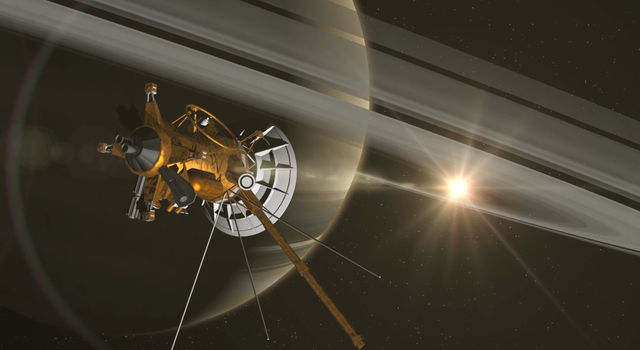
NASA's Cassini spacecraft, in orbit around Saturn since 2004, is about to begin the final chapter of its remarkable story. On Wednesday, April 26, the spacecraft will make the first in a series of dives through the 1,500-mile-wide (2,400-kilometer) gap between Saturn and its rings as part of the mission's grand finale.

"No spacecraft has ever gone through the unique region that we'll attempt to boldly cross 22 times," said Thomas Zurbuchen, associate administrator for the Science Mission Directorate at NASA Headquarters in Washington. "What we learn from Cassini's daring final orbits will further our understanding of how giant planets, and planetary systems everywhere, form and evolve. This is truly discovery in action to the very end."

› DOWNLOAD VIDEO Cassini's Grand Finale

During its time at Saturn, Cassini has made numerous dramatic discoveries, including a global ocean that showed indications of hydrothermal activity within the icy moon Enceladus, and liquid methane seas on its moon Titan.

Now 20 years since launching from Earth, and after 13 years orbiting the ringed planet, Cassini is running low on fuel. In 2010, NASA decided to end the mission with a purposeful plunge into Saturn this year in order to protect and preserve the planet's moons for future exploration -- especially the potentially habitable Enceladus.

But the beginning of the end for Cassini is, in many ways, like a whole new mission. Using expertise gained over the mission's many years, Cassini engineers designed a flight plan that will maximize the scientific value of sending the spacecraft toward its fateful plunge into the planet on Sept. 15. As it ticks off its terminal orbits during the next five months, the mission will rack up an impressive list of scientific achievements.

"This planned conclusion for Cassini's journey was far and away the preferred choice for the mission's scientists," said Linda Spilker, Cassini project scientist at NASA's Jet Propulsion Laboratory in Pasadena, California. "Cassini will make some of its most extraordinary observations at the end of its long life."

The mission team hopes to gain powerful insights into the planet's internal structure and the origins of the rings, obtain the first-ever sampling of Saturn's atmosphere and particles coming from the main rings, and capture the closest-ever views of Saturn's clouds and inner rings. The team currently is making final checks on the list of commands the robotic probe will follow to carry out its science observations, called a sequence, as it begins the finale. That sequence is scheduled to be uploaded to the spacecraft on Tuesday, April 11.

Cassini will transition to its grand finale orbits, with a last close flyby of Saturn's giant moon Titan, on Saturday, April 22. As it has many times over the course of the mission, Titan's gravity will bend Cassini's flight path. Cassini's orbit then will shrink so that instead of making its closest approach to Saturn just outside the rings, it will begin passing between the planet and the inner edge of its rings.

"Based on our best models, we expect the gap to be clear of particles large enough to damage the spacecraft. But we're also being cautious by using our large antenna as a shield on the first pass, as we determine whether it's safe to expose the science instruments to that environment on future passes," said Earl Maize, Cassini project manager at JPL. "Certainly there are some unknowns, but that's one of the reasons we're doing this kind of daring exploration at the end of the mission."

In mid-September, following a distant encounter with Titan, the spacecraft's path will be bent so that it dives into the planet. When Cassini makes its final plunge into Saturn's atmosphere on Sept. 15, it will send data from several instruments - most notably, data on the atmosphere's composition -- until its signal is lost.

"Cassini's grand finale is so much more than a final plunge," said Spilker. "It's a thrilling final chapter for our intrepid spacecraft, and so scientifically rich that it was the clear and obvious choice for how to end the mission."

Resources on Cassini's grand finale, including images and video, are available at:

http://saturn.jpl.nasa.gov/grandfinale

An animated video about Cassini's Grand Finale is available at:

https://youtu.be/xrGAQCq9BMU

The Cassini-Huygens mission is a cooperative project of NASA, ESA (European Space Agency) and the Italian Space Agency. JPL manages the mission for NASA's Science Mission Directorate. JPL designed, developed and assembled the Cassini orbiter.

More information about Cassini is at:

http://www.nasa.gov/cassini

http://saturn.jpl.nasa.gov


This message was sent to chantybanty1.chanti@blogger.com from:

NASA Jet Propulsion Laboratory | jplnewsroom@jpl.nasa.gov | NASA's Jet Propulsion Laboratory | 4800 Oak Grove Dr | Pasadena, CA 91109

Monday, April 3, 2017

The energy of bright feelings. Cialis Professional.

The energy of bright feelings. Cialis Professional.

Limited period offer till stocks last

Shop now with us! Cialis Professional is popular like no other! Buy online!

- Fast WorldWide shipping
- Secure ordering
- Lowest price
- Get Free Bonus

SALE2017

Use this code and get
ADDITIONAL discount 5%
for all our product.
Use this link if button not work. Copy and paste the link to your browser

http://lTaZ.stablemysale.ru
 
Copyright © Canadian Pharmacy, All rights reserved.