MY SEARCH ENGINE

Monday, December 15, 2008

Phoenix Site on Mars May be in Dry Climate Cycle Phase

Guy Webster 818-354-6278
Jet Propulsion Laboratory, Pasadena, Calif.
guy.webster@jpl.nasa.gov

Rachel Prucey 650-604-0643
NASA Ames Research Center, Moffett Field, Calif.
rachel.l.prucey@nasa.gov

Lori Stiles 520-626-4402
University of Arizona, Tucson
lstiles@u.arizona.edu

News release: 2008-236 December 15, 2008

Phoenix Site on Mars May Be in Dry Climate Cycle Phase

PASADENA, Calif. -- The Martian arctic soil that NASA's Phoenix Mars Lander dug into this year is very cold
and very dry. However, when long-term climate cycles make the site warmer, the soil may get moist enough to
modify the chemistry, producing effects that persist through the colder times.

Phoenix found clues increasing scientists' confidence in predictive models about water vapor moving through
the soil between the atmosphere and subsurface water-ice. The models predict the vapor flow can wet the soil
when the tilt of Mars' axis, the obliquity, is greater than it is now.

The robot worked on Mars for three months of prime mission, plus two months of overtime, after landing on
May 25. The Phoenix science team will be analyzing data and running comparison experiments for months to
come. With some key questions still open, team members at a meeting of the American Geophysical Union
today reported on their progress.

"We have snowfall from the clouds and frost at the surface, with ice just a few inches below, and dry soil in
between," said Phoenix Principal Investigator Peter Smith of the University of Arizona, Tucson. "During a
warmer climate several million years ago, the ice would have been deeper, but frost on the surface could have
melted and wet the soil."

With no large moon like Earth's to stabilize it, Mars goes through known periodic cycles when its tilt becomes
much greater than Earth's. During those high-tilt periods, the sun rises higher in the sky above the Martian
poles than it does now, and the arctic plain where Phoenix worked experiences warmer summers.

"The ice under the soil around Phoenix is not a sealed-off deposit left from some ancient ocean," said Ray
Arvidson of Washington University in St. Louis, lead scientist for the lander's robotic arm. "It is in equilibrium
with the environment, and the environment changes with the obliquity cycles on scales from hundreds of
thousands of years to a few million years. There have probably been dozens of times in the past 10 million
years when thin films of water were active in the soil, and probably there will be dozens more times in the next
10 million years."

Cloddy texture of soil scooped up by Phoenix is one clue to effects of water. The mission's microscopic
examination of the soil shows individual particles characteristic of windblown dust and sand, but clods of the
soil hold together more cohesively than expected for unaltered dust and sand. Arvidson said, "It's not strongly
cemented. It would break up in your hand, but the cloddiness tells us that something is taking the windblown
material and mildly cementing it."

That cementing effect could result from water molecules adhering to the surfaces of soil particles. Or it could
be from water mobilizing and redepositing salts that Phoenix identified in the soil, such as magnesium
perchlorate and calcium carbonate.

The Thermal and Electrical Conductivity Probe on Phoenix detected electrical-property changes consistent
with accumulation of water molecules on surfaces of soil grains during daily cycles of water vapor moving
through the soil, reported Aaron Zent of NASA Ames Research Center, Moffett Field, Calif., lead scientist for
that probe.

"There's exchange between the atmosphere and the subsurface ice," Zent said. "A film of water molecules
accumulates on the surfaces of mineral particles. It's not enough right now to transform the chemistry, but the
measurements are providing verification that these molecular films are occurring when you would expect them
to, and this gives us more confidence in predicting the way they would behave in other parts of the obliquity
cycles."

The Phoenix mission is led by Smith at the University of Arizona with project management at NASA's Jet
Propulsion Laboratory, Pasadena, Calif., and development partnership at Lockheed Martin, Denver.
International contributions come from the Canadian Space Agency; the University of Neuchatel, Switzerland;
the universities of Copenhagen and Aarhus, Denmark; Max Planck Institute, Germany; and the Finnish
Meteorological Institute; and Imperial College, London. For more about Phoenix, visit:
http://www.nasa.gov/phoenix.

-end-


To remove yourself from this mailing, please go to http://www.kintera.org/TR.asp?a=erJNLVOzFhKQL8I&s=ggLULVPxGcKGKUPDIqG&m=hfLSKZMuEeIYH

To remove yourself from all mailings from NASA Jet Propulsion Laboratory, please go to http://www.kintera.org/TR.asp?a=huLTI4PLIkJXJiL&s=ggLULVPxGcKGKUPDIqG&m=hfLSKZMuEeIYH

Saturn's Dynamic Moon Enceladus Shows More Signs of Activity

Carolina Martinez 818-354-9382
Jet Propulsion Laboratory, Pasadena, Calif.
carolina.martinez@jpl.nasa.gov

Steve Cole 202-657-2194
Headquarters, Washington
stephen.e.cole@nasa.gov

News release: 2008-235 Dec. 15, 2008

Saturn's Dynamic Moon Enceladus Shows More Signs of Activity

PASADENA, Calif. -- The closer scientists look at Saturn's small moon Enceladus, the more they find evidence
of an active world. The most recent flybys of Enceladus made by NASA's Cassini spacecraft have provided
new signs of ongoing changes on and around the moon. The latest high-resolution images of Enceladus show
signs that the south polar surface changes over time.

Close views of the southern polar region, where jets of water vapor and icy particles spew from vents within
the moon's distinctive "tiger stripe" fractures, provide surprising evidence of Earth-like tectonics. They yield
new insight into what may be happening within the fractures. The latest data on the plume -- the huge cloud of
vapor and particles fed by the jets that extend into space -- show it varies over time and has a far-reaching
effect on Saturn's magnetosphere.

"Of all the geologic provinces in the Saturn system that Cassini has explored, none has been more thrilling or
carries greater implications than the region at the southernmost portion of Enceladus," said Carolyn Porco,
Cassini imaging team leader at the Space Science Institute in Boulder, Colo.

A panel of Cassini scientists, including Porco, presented these new findings today in a news briefing at the
American Geophysical Union's fall meeting in San Francisco.

"Enceladus has Earth-like spreading of the icy crust, but with an exotic difference -- the spreading is almost all
in one direction, like a conveyor belt," said panelist Paul Helfenstein, Cassini imaging associate at Cornell
University in Ithaca, N.Y. "Asymmetric spreading like this is unusual on Earth and not well understood."

"Enceladus has asymmetric spreading on steroids," Helfenstein added. "We are not certain about the
geological mechanisms that control the spreading, but we see patterns of divergence and mountain-building
similar to what we see on Earth, which suggests that subsurface heat and convection are involved."

The tiger stripes are analogous to the mid-ocean ridges on Earth's seafloor where volcanic material wells up
and creates new crust. Using Cassini-based digital maps of the south polar region of Enceladus, Helfenstein
reconstructed a possible history of the tiger stripes by working backward in time and progressively snipping
away older and older sections of the map. Each time he found that the remaining sections fit together like
puzzle pieces.

Images from recent close Enceladus flybys also have bolstered an idea the Cassini imaging team has that
condensation from the jets erupting from the surface may create ice plugs that close off old vents and force
new vents to open. The opening and clogging of vents also corresponds with measurements indicating the
plume varies from month to month and year to year.

"We see no obvious distinguishing markings on the surface in the immediate vicinity of each jet source, which
suggests that the vents may open and close and thus migrate up and down the fractures over time," Porco
said. "Over time, the particles that rain down onto the surface from the jets may form a continuous blanket of
snow along a fracture."

Enceladus' output of ice and vapor dramatically impacts the entire Saturnian system by supplying the ring
system with fresh material and loading ionized gas from water vapor into Saturn's magnetosphere.

"The ions added to the magnetosphere are spun up from Enceladus' orbital speed to the rotational speed of
Saturn," said Cassini magnetometer science team member Christopher Russell of the University of California,
Los Angeles. "The more material is added by the plume, the harder this is for Saturn to do, and the longer it
takes to accelerate the new material."

With water vapor, organic compounds and excess heat emerging from Enceladus' south polar terrain,
scientists are intrigued by the possibility of a liquid-water-rich habitable zone beneath the moon's south pole.

Cassini's flybys on Aug. 11 and Oct. 31 of this year targeted Enceladus' fractured southern region. An Oct. 9
flyby took the spacecraft deep into the plume of water vapor and ice shooting out of the moon's vents.
Cassini's next flyby of Enceladus will be in November 2009.

The Cassini-Huygens mission is a cooperative project of NASA, the European Space Agency and the Italian
Space Agency. The Jet Propulsion Laboratory, a division of the California Institute of Technology in Pasadena,
manages the Cassini-Huygens mission for NASA's Science Mission Directorate, Washington. The Cassini
orbiter and its two onboard cameras were designed, developed and assembled at JPL. The imaging team is
based at the Space Science Institute, Boulder, Colo. The magnetometer team is based at Imperial College in
London, working with team members from the United States and several European countries.

For more information about the Cassini-Huygens mission, visit: http://www.nasa.gov/cassini and
http://saturn.jpl.nasa.gov.

-end-


To remove yourself from this mailing, please go to http://www.kintera.org/TR.asp?a=gjKQJ8PTLpI3LlK&s=jtL0K4NJKfIMK3PPItF&m=iqKUK1OwFgK2E

To remove yourself from all mailings from NASA Jet Propulsion Laboratory, please go to http://www.kintera.org/TR.asp?a=ehKMJ2OMIfLHI6I&s=jtL0K4NJKfIMK3PPItF&m=iqKUK1OwFgK2E

Thursday, December 11, 2008

Mars Orbiter Completes Prime Mission

MEDIA RELATIONS OFFICE
JET PROPULSION LABORATORY
CALIFORNIA INSTITUTE OF TECHNOLOGY
NATIONAL AERONAUTICS AND SPACE ADMINISTRATION
PASADENA, CALIFORNIA 91109. TELEPHONE 818-354-5011
http://www.jpl.nasa.gov

Guy Webster 818-354-6278
Jet Propulsion Laboratory, Pasadena, Calif.
guy.webster@jpl.nasa.gov

Dwayne Brown 202-358-1726
NASA Headquarters, Washington
dwayne.c.brown@nasa.gov

NEWS RELEASE: 2008-234 Dec. 11, 2008

Mars Orbiter Completes Prime Mission

PASADENA, Calif. -- NASA's Mars Reconnaissance Orbiter has completed its primary, two-year
science phase. The spacecraft has found signs of a complex Martian history of climate change that
produced a diversity of past watery environments.

The orbiter has returned 73 terabits of science data, more than all earlier Mars missions combined.
The spacecraft will build on this record as it continues to examine Mars in unprecedented detail
during its next two-year phase of science operations.

Among the major findings during the primary science phase is the revelation that the action of water
on and near the surface of Mars occurred for hundreds of millions of years. This activity was at least
regional and possibly global in extent, though possibly intermittent. The spacecraft also observed that
signatures of a variety of watery environments, some acidic, some alkaline, increase the possibility
that there are places on Mars that could reveal evidence of past life, if it ever existed.

Since moving into position 186 miles above Mars' surface in October 2006, the orbiter also has
conducted 10,000 targeted observation sequences of high-priority areas. It has imaged nearly 40
percent of the planet at a resolution that can reveal house-sized objects in detail, with one percent in
enough detail to see desk-sized features. This survey has covered almost 60 percent of Mars in
mineral mapping bands at stadium-size resolution. The orbiter also assembled nearly 700 daily global
weather maps, dozens of atmospheric temperature profiles, and hundreds of radar profiles of the
subsurface and the interior of the polar caps.

"These observations are now at the level of detail necessary to test hypotheses about when and where
water has changed Mars and where future missions will be most productive as they search for
habitable regions on Mars," said Richard Zurek, Mars Reconnaissance Orbiter project scientist at
NASA's Jet Propulsion Laboratory in Pasadena, Calif.

Included in the observations are hundreds of stereo pairs used to make detailed topography maps and
classic images in support of other Mars missions. One image showed the Mars rover Opportunity
poised on the rim of Victoria Crater, and another was of NASA's Phoenix Mars Lander during its
descent to the surface. Orbiter data prompted the Phoenix team to change the spacecraft's landing site,
and are being used to select the landing location for NASA's Mars Science Laboratory, which is
scheduled for launch in 2011. For five months of Phoenix operations on Mars that ended in
November, the Mars Reconnaissance Orbiter and NASA's Mars Odyssey orbiter shared the vital
communications roles of relaying commands to the lander, and data from Phoenix back to Earth.

The Mars Reconnaissance Orbiter has found repetitive layering in Mars' permanent polar ice caps.
The patterns suggest climate change cycles continuing to the present. They may record possible
effects of cyclical changes in Mars' tilt and orbit on global sunlight patterns. Recent climate cycles
are indicated by radar detection of subsurface icy deposits outside the polar regions, closer to the
equator, where near-surface ice is not permanently stable. Other results reveal details of ancient
streambeds, atmospheric hazes and motions of water, along with the ever-changing weather on Mars.

Most observations from the orbiter will be discontinued for a few weeks while the sun is between
Earth and Mars, which will disrupt communications. This month, the orbiter will begin a new phase,
with science observations continuing as Mars makes another orbit around the sun, which takes
approximately two Earth years.

"This spacecraft truly exemplifies the best in capabilities to support science and other Martian
spacecraft activities," said Michael Meyer, lead scientist for the Mars Exploration Program at NASA
Headquarters in Washington. "MRO has exceeded its own goals and our expectations. We look
forward to more discoveries as we continue to look at the Red Planet in spectacular detail."

NASA's Jet Propulsion Laboratory in Pasadena manages the Mars Reconnaissance Orbiter for
NASA's Science Mission Directorate, Washington. Lockheed Martin Space Systems, Denver, is the
prime contractor for the project and built the spacecraft. For more information about the mission,
visit: http://www.nasa.gov/mro .

-end-


To remove yourself from this mailing, please go to http://www.kintera.org/TR.asp?a=huISK3PQLlKWKlL&s=eoKQIPMpFaLCJONvEoH&m=fnJNLONiEaKSE

To remove yourself from all mailings from NASA Jet Propulsion Laboratory, please go to http://www.kintera.org/TR.asp?a=anJELIMoFeJJI1K&s=eoKQIPMpFaLCJONvEoH&m=fnJNLONiEaKSE

Wednesday, December 10, 2008

Astronomers Find the Two Dimmest Stellar Bulbs

MEDIA RELATIONS OFFICE
JET PROPULSION LABORATORY
CALIFORNIA INSTITUTE OF TECHNOLOGY
NATIONAL AERONAUTICS AND SPACE ADMINISTRATION
PASADENA, CALIFORNIA 91109. TELEPHONE 818-354-5011
http://www.jpl.nasa.gov

Whitney Clavin 818-354-4673
Jet Propulsion Laboratory, Pasadena, Calif.
whitney.clavin@jpl.nasa.gov

NEWS RELEASE: 2008-232 Dec. 10, 2008

Astronomers Find the Two Dimmest Stellar Bulbs

It's a tie! The new record-holder for dimmest known star-like object in the universe goes to twin
"failed" stars, or brown dwarfs, each of which shines feebly with only one millionth the light of
our sun.

Previously, astronomers thought the pair of dim bulbs was just one typical, faint brown dwarf
with no record-smashing titles. But when NASA's Spitzer Space Telescope observed the brown
dwarf with its heat-seeking infrared vision, it was able to accurately measure the object's extreme
faintness and low temperature for the first time. What's more, the Spitzer data revealed the brown
dwarf is, in fact, twins.

"Both of these objects are the first to break the barrier of one millionth the total light-emitting
power of the sun," said Adam Burgasser of the Massachusetts Institute of Technology,
Cambridge. Burgasser is lead author of a new paper about the discovery appearing in the
Astrophysical Journal Letters.

Brown dwarfs are the misfits of the cosmos. They are compact balls of gas floating freely in
space, but they are too cool and lightweight to be stars, and too warm and massive to be planets.
The name "brown dwarf" comes from the fact that these small, star-like bodies change color over
time as they cool, and thus have no definitive color. In reality, most brown dwarfs would appear
reddish if they could be seen with the naked eye. Their feeble light output also means they are
hard to find. The first brown dwarf wasn't discovered until 1995. While hundreds are known
today, astronomers say there are many more in space still waiting to be discovered.

The newfound dim duo of brown dwarfs, while notable for their exceptional faintness, will
probably not be remembered for their name. They are called 2MASS J09393548-2448279 after
the Two Micron All-Sky Survey, or "2MASS," the mission partially funded by NASA that first
detected the object in 1999.

Astronomers recently used Spitzer's ultrasensitive infrared vision to learn more about the object,
which was still thought to be a solo brown dwarf. These data revealed a warm atmospheric
temperature of 565 to 635 Kelvin (560 to 680 degrees Fahrenheit). While this is hundreds of
degrees hotter than Jupiter, it's still downright cold as far as stars go. In fact, 2MASS J09393548-
2448279, or 2M 0939 for short, is one of the coldest star-like bodies measured so far.

To calculate the object's brightness, the researchers had to first determine its distance from Earth.
After three years of precise measurements with the Anglo-Australian Observatory in Australia,
they concluded that 2M 0939 is the fifth-closest known brown dwarf to us, 17 light-years away
toward the constellation Antlia. This distance, together with Spitzer's measurements, told the
astronomers the object was both cool and extremely dim.

But something was puzzling. The brightness of the object was twice what would be expected for
a brown dwarf with its particular temperature. The solution? The object must have twice the
surface area. In other words, it's twins, with each body shining only half as bright, and each with
a mass of 30 to 40 times that of Jupiter. Both bodies are one million times fainter than the sun in
total light, and at least one billion times fainter in visible light alone.

"These brown dwarfs are the lowest power stellar light bulbs in the sky that we know of," said
Burgasser. "And like low-energy fluorescent light bulbs, they emit most of their light in a narrow
range of wavelengths, in this case in the infrared."

According to the authors, there are even dimmer brown dwarfs scattered throughout the universe,
most too faint to see with current sky surveys. NASA's upcoming Wide-Field Infrared Survey
Explorer mission will scan the entire sky at infrared wavelengths, and is expected to uncover
hundreds of these inconspicuous characters.

"The holy grail in the study of brown dwarfs is to find out how low you can go in terms of
temperature, mass and brightness," said Davy Kirkpatrick, a co-author of the paper at NASA's
Infrared Processing and Analysis Center at the California Institute of Technology, Pasadena.
"This will tell us more about how brown dwarfs form and evolve."

Other authors of this paper are Chris Tinney of the University of New South Wales, Australia;
Michael C. Cushing of the University of Hawaii, Manoa; Didier Saumon of the Los Alamos
National Laboratory, NM; Mark S. Marley, NASA Ames Research Center, Moffett Field, Calif.;
and Clara S. Bennett of the Massachusetts Institute of Technology.

NASA's Jet Propulsion Laboratory, Pasadena, Calif., manages the Spitzer Space Telescope
mission for NASA's Science Mission Directorate, Washington. Science operations are conducted
at the Spitzer Science Center at the California Institute of Technology, also in Pasadena. Caltech
manages JPL for NASA. More information about Spitzer is at:
http://www.spitzer.caltech.edu/spitzer and http://www.nasa.gov/spitzer .

-end-


To remove yourself from this mailing, please go to http://www.kintera.org/TR.asp?a=beIFJNMtGgIILYJ&s=dnIOKMPlE9IAILNrHnF&m=muL0KbNMJhI7E

To remove yourself from all mailings from NASA Jet Propulsion Laboratory, please go to http://www.kintera.org/TR.asp?a=erKLJWOFIjLPI8I&s=dnIOKMPlE9IAILNrHnF&m=muL0KbNMJhI7E

Tuesday, December 9, 2008

Oscillation Rules as the Pacific Cools

MEDIA RELATIONS OFFICE
JET PROPULSION LABORATORY
CALIFORNIA INSTITUTE OF TECHNOLOGY
NATIONAL AERONAUTICS AND SPACE ADMINISTRATION
PASADENA, CALIFORNIA 91109. TELEPHONE 818-354-5011
http://www.jpl.nasa.gov

Alan Buis 818-354-0474
Jet Propulsion Laboratory, Pasadena, Calif.
Alan.buis@jpl.nasa.gov

IMAGE ADVISORY: 2008-231 Dec. 9, 2008

Oscillation Rules as the Pacific Cools

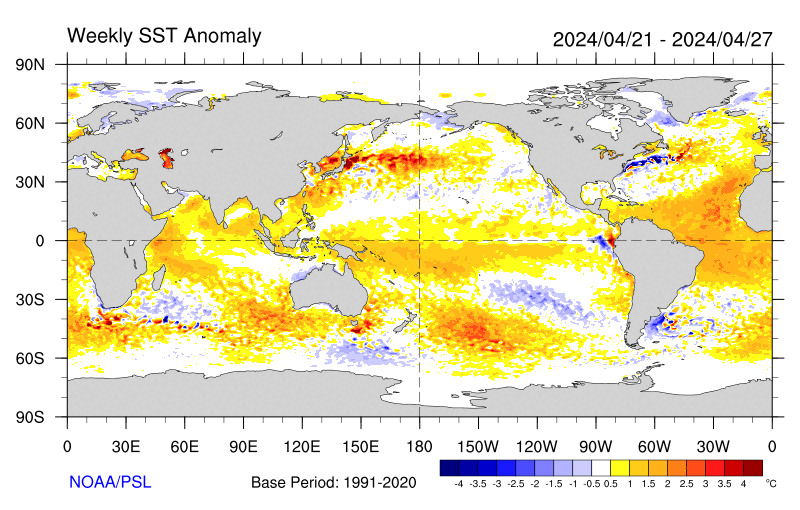
PASADENA, Calif. -- The latest image of sea-surface height measurements from the
U.S./French Jason-1 oceanography satellite shows the Pacific Ocean remains locked in a
strong, cool phase of the Pacific Decadal Oscillation, a large, long-lived pattern of
climate variability in the Pacific associated with a general cooling of Pacific waters. The
image also confirms that El Niño and La Niña remain absent from the tropical Pacific.

The new image is available online at:
http://www.nasa.gov/topics/earth/features/20081209.html .

The image is based on the average of 10 days of data centered on Nov. 15, 2008,
compared to the long-term average of observations from 1993 through 2008. In the
image, places where the Pacific sea-surface height is higher (warmer) than normal are
yellow and red, and places where the sea surface is lower (cooler) than normal are blue
and purple. Green shows where conditions are near normal. Sea-surface height is an
indicator of the heat content of the upper ocean.

The Pacific Decadal Oscillation is a long-term fluctuation of the Pacific Ocean that
waxes and wanes between cool and warm phases approximately every five to 20 years. In
the present cool phase, higher-than-normal sea-surface heights caused by warm water
form a horseshoe pattern that connects the north, west and southern Pacific. This is in
contrast to a cool wedge of lower-than-normal sea-surface heights spreading from the
Americas into the eastern equatorial Pacific. During most of the 1980s and 1990s, the
Pacific was locked in the oscillation's warm phase, during which these warm and cool
regions are reversed. For an explanation of the Pacific Decadal Oscillation and its present
state, see: http://jisao.washington.edu/pdo/ and http://www.esr.org/pdo_index.html .

Sea-surface temperature satellite data from the National Oceanic and Atmospheric
Administration mirror Jason sea-surface height measurements, clearly showing a cool
Pacific Decadal Oscillation pattern, as seen at:
http://www.cdc.noaa.gov/map/images/sst/sst.anom.gif .

"This multi-year Pacific Decadal Oscillation 'cool' trend can cause La Niña-like impacts
around the Pacific basin," said Bill Patzert, an oceanographer and climatologist at
NASA's Jet Propulsion Laboratory, Pasadena, Calif. "The present cool phase of the
Pacific Decadal Oscillation will have significant implications for shifts in marine
ecosystems, and for land temperature and rainfall patterns around the Pacific basin."

According to Nathan Mantua of the Climate Impacts Group at the University of
Washington, Seattle, whose research contributed to the early understanding of the Pacific
Decadal Oscillation, "Even with the strong La Niña event fading in the tropics last spring,
the North Pacific's sea surface temperature anomaly pattern has remained strongly
negative since last fall. This cool phase will likely persist this winter and, perhaps,
beyond. Historically, this situation has been associated with favorable ocean conditions
for the return of U.S. west coast Coho and Chinook salmon, but it translates to low odds
for abundant winter/spring precipitation in the southwest (including Southern
California)."

Jason's follow-on mission, the Ocean Surface Topography Mission/Jason-2, was
successfully launched this past June and will extend to two decades the continuous data
record of sea surface heights begun by Topex/Poseidon in 1992. The new mission has
produced excellent data, which have recently been certified for operational use. Fully
calibrated and validated data for science use will be released next spring.

JPL manages the U.S. portion of the Jason-1 mission for NASA's Science Mission
Directorate, Washington. JPL is managed for NASA by the California Institute of
Technology in Pasadena.

For more information on NASA's ocean surface topography missions, visit
http://sealevel.jpl.nasa.gov/ . To view the latest Jason-1 data, visit
http://sealevel.jpl.nasa.gov/science/jason1-quick-look/ .

-end-

To remove yourself from this mailing, please go to http://www.kintera.org/TR.asp?a=huLRI3POIgJWJnL&s=llK4KaMRKhIQL9MXLvG&m=igJSIWNsH6JTH

To remove yourself from all mailings from NASA Jet Propulsion Laboratory, please go to http://www.kintera.org/TR.asp?a=boIFJLMqGaILL6J&s=llK4KaMRKhIQL9MXLvG&m=igJSIWNsH6JTH

Hubble Telescope Finds Carbon Dioxide on an Extrasolar Planet

MEDIA RELATIONS OFFICE
JET PROPULSION LABORATORY
CALIFORNIA INSTITUTE OF TECHNOLOGY
NATIONAL AERONAUTICS AND SPACE ADMINISTRATION
PASADENA, CALIFORNIA 91109. TELEPHONE 818-354-5011
http://www.jpl.nasa.gov

Whitney Clavin 818-354-4673
Jet Propulsion Laboratory
whitney.clavin@jpl.nasa.gov

J.D. Harrington 202-358-5241
NASA Headquarters, Washington
j.d.harrington@nasa.gov

Ray Villard 410-338-4514
Space Telescope Science Institute, Baltimore, Md.
villard@stsci.edu

IMAGE ADVISORY: 2008-230 Dec. 9, 2008

Hubble Telescope Finds Carbon Dioxide on an Extrasolar Planet

PASADENA, Calif. -- NASA's Hubble Space Telescope has discovered carbon dioxide in the
atmosphere of a planet orbiting another star. This breakthrough is an important step toward finding
chemical biotracers of extraterrestrial life.

The Jupiter-sized planet, called HD 189733b, is too hot for life. But the Hubble observations are a
proof-of-concept demonstration that the basic chemistry for life can be measured on planets orbiting
other stars. Organic compounds also can be a by-product of life processes, and their detection on an
Earthlike planet someday may provide the first evidence of life beyond our planet.

Previous observations of HD 189733b by Hubble and NASA's Spitzer Space Telescope found water
vapor. Earlier this year, Hubble found methane in the planet's atmosphere.

"Hubble was conceived primarily for observations of the distant universe, yet it is opening a new era
of astrophysics and comparative planetary science," said Eric Smith, Hubble Space Telescope
program scientist at NASA Headquarters in Washington. "These atmospheric studies will begin to
determine the compositions and chemical processes operating on distant worlds orbiting other stars.
The future for this newly opened frontier of science is extremely promising as we expect to discover
many more molecules in exoplanet atmospheres."

Mark Swain, a research scientist at NASA's Jet Propulsion Laboratory in Pasadena, Calif., used
Hubble's near-infrared camera and multi-object spectrometer to study infrared light emitted from the
planet, which lies 63 light-years away. Gases in the planet's atmosphere absorb certain wavelengths
of light from the planet's hot glowing interior. Swain identified carbon dioxide and carbon monoxide.
The molecules leave a unique spectral fingerprint on the radiation from the planet that reaches Earth.
This is the first time a near-infrared emission spectrum has been obtained for an exoplanet.


"The carbon dioxide is the main reason for the excitement because, under the right circumstances, it
could have a connection to biological activity as it does on Earth," Swain said. "The very fact we are
able to detect it and estimate its abundance is significant for the long-term effort of characterizing
planets to find out what they are made of and if they could be a possible host for life."

This type of observation is best done on planets with orbits tilted edge-on to Earth. They routinely
pass in front of and then behind their parent stars, phenomena known as eclipses. The planet HD
189733b passes behind its companion star once every 2.2 days. The eclipses allow an opportunity to
subtract the light of the star alone, when the planet is blocked, from that of the star and planet
together prior to eclipse. That isolates the emission of the planet and makes possible a chemical
analysis of its atmosphere.

"In this way, we are using the eclipse of the planet behind the star to probe the planet's day side,
which contains the hottest portions of its atmosphere," said team member Guatam Vasisht of JPL.
"We are starting to find the molecules and to figure out how many there are to see the changes
between the day side and the night side."

This successful demonstration of looking at near-infrared light emitted from a planet is very
encouraging for astronomers planning to use NASA's James Webb Space Telescope after it is
launched in 2013. These biomarkers are best seen at near-infrared wavelengths. Astronomers look
forward to using the Webb telescope to look spectroscopically for biomarkers on a terrestrial planet
the size of Earth or a "super-Earth" several times our planet's mass.

"The Webb telescope should be able to make much more sensitive measurements of these primary
and secondary eclipse events," Swain said.

More information about the Hubble space telescope is at http://www.nasa.gov/hubble .

-end-


To remove yourself from this mailing, please go to http://www.kintera.org/TR.asp?a=cfLHJNNoEcKNI3I&s=ggJUIVNxHcLGIUNDKqH&m=fnJLLVPqF8IRG

To remove yourself from all mailings from NASA Jet Propulsion Laboratory, please go to http://www.kintera.org/TR.asp?a=fiINJWOAKfJUKdL&s=ggJUIVNxHcLGIUNDKqH&m=fnJLLVPqF8IRG

Monday, December 8, 2008

Rivers of Gas Flow Around Stars in New Space Image

MEDIA RELATIONS OFFICE
JET PROPULSION LABORATORY
CALIFORNIA INSTITUTE OF TECHNOLOGY
NATIONAL AERONAUTICS AND SPACE ADMINISTRATION
PASADENA, CALIFORNIA 91109. TELEPHONE 818-354-5011
http://www.jpl.nasa.gov

Whitney Clavin 818-354-4673
Jet Propulsion Laboratory
whitney.clavin@jpl.nasa.gov

IMAGE ADVISORY: 2008-228 Dec. 8, 2008

Rivers of Gas Flow Around Stars in New Space Image

A new image from NASA's Spitzer Space Telescope shows a turbulent star-forming
region, where rivers of gas and stellar winds are eroding thickets of dusty material.

The picture provides some of the best examples yet of the ripples of gas, or bow shocks,
that can form around stars in choppy cosmic waters.

"The stars are like rocks in a rushing river," said Matt Povich of the University of
Wisconsin, Madison. "Powerful winds from the most massive stars at the center of the
cloud produce a large flow of expanding gas. This gas then piles up with dust in front of
winds from other massive stars that are pushing back against the flow." Povich is lead
author of a paper describing the new findings in the Dec. 10 issue of the Astrophysical
Journal.

Spitzer's new infrared view of the stormy region, called M17, or the Swan nebula, is
online at http://www.nasa.gov/mission_pages/spitzer/multimedia/20081208.html .
The Swan is located about 6,000 light-years away in the constellation Sagittarius.

Dominating the center of the Swan is a group of massive stars, some exceeding 40 times
the mass of our sun. These central stars are 100,000 to one million times as bright as the
sun, and roar with radiation and fierce winds made of charged particles that speed along
at up to 7.2 kilometers per hour (4.5 million miles per hour). Both the wind and radiation
carve out a deep cavity at the center of the picture -- an ongoing process thought to
trigger the birth of new stars.

The growth of this cavity pushes gas up against winds from other massive stars, causing
"smiley-faced" bow shocks -- three of which can be seen in the new picture. The
direction of the bow shocks tells researchers exactly which way the "wind is blowing."

"The bow shocks are like interstellar weather vanes, indicating the direction of the stellar
winds in the nebula," said Povich.

Povich and his colleagues also used Spitzer to take an infrared picture of a star-forming
region called RCW 49. Both photographs are described in the same Astrophysical Journal
paper, and both provide the first examples of multiple bow shocks around the massive
stars of star-forming regions.

Spitzer was able to spot the bow shocks because its infrared eyes can pierce intervening
dust, and because it can photograph large swaths of sky quickly.

Ultimately, the new observations will help researchers understand how solar systems like
our own are able to form and persist in the rough, celestial seas of space.

"The gas being lit up in these star-forming regions looks very wispy and fragile, but looks
can be deceiving," said co-author Robert Benjamin of the University of Wisconsin,
Whitewater. "These bow shocks serve as a reminder that stars aren't born in quiet
nurseries but in violent regions buffeted by winds more powerful than anything we see on
Earth."

Other authors include Barbara A. Whitney of the Space Science Institute, Boulder, Colo.;
Brian L. Babler, Marilyn R. Meade and Ed Churchwell of the University of Wisconsin,
Madison; and Remy Indebetouw of the University of Virginia, Charlottesville.

NASA's Jet Propulsion Laboratory, Pasadena, Calif., manages the Spitzer Space
Telescope mission for NASA's Science Mission Directorate, Washington. Science
operations are conducted at the Spitzer Science Center at the California Institute of
Technology, also in Pasadena. Caltech manages JPL for NASA. Spitzer's infrared array
camera was built by NASA's Goddard Space Flight Center, Greenbelt, Md. The
instrument's principal investigator is Giovanni Fazio of the Harvard-Smithsonian Center
for Astrophysics.

For more information about Spitzer, visit http://www.spitzer.caltech.edu/spitzer and
http://www.nasa.gov/spitzer .

-end-


To remove yourself from this mailing, please go to http://www.kintera.org/TR.asp?a=jmJUIaMZKjLSKlJ&s=jtI0I4NJKfIMK3MPLtG&m=jrJTI0MHLoK3H

To remove yourself from all mailings from NASA Jet Propulsion Laboratory, please go to http://www.kintera.org/TR.asp?a=cfLGJPNxEcKFI1I&s=jtI0I4NJKfIMK3MPLtG&m=jrJTI0MHLoK3H

Thursday, December 4, 2008

Next NASA Mars Mission Rescheduled for 2011

MEDIA RELATIONS OFFICE
JET PROPULSION LABORATORY
CALIFORNIA INSTITUTE OF TECHNOLOGY
NATIONAL AERONAUTICS AND SPACE ADMINISTRATION
PASADENA, CALIF. 91109 TELEPHONE 818-354-5011
http://www.jpl.nasa.gov

Guy Webster 818-354-6278
Jet Propulsion Laboratory, Pasadena, Calif.
guy.webster@jpl.nasa.gov

Dwayne Brown 202-358-1726
NASA Headquarters, Washington
dwayne.c.brown@nasa.gov

NEWS RELEASE: 2008-226 December 4, 2008

Next NASA Mars Mission Rescheduled for 2011

WASHINGTON -- NASA's Mars Science Laboratory will launch two years later than previously
planned, in the fall of 2011. The mission will send a next-generation rover with unprecedented
research tools to study the early environmental history of Mars.

A launch date of October 2009 no longer is feasible because of testing and hardware challenges that
must be addressed to ensure mission success. The window for a 2009 launch ends in late October.
The relative positions of Earth and Mars are favorable for flights to Mars only a few weeks every two
years. The next launch opportunity after 2009 is in 2011.

"We will not lessen our standards for testing the mission's complex flight systems, so we are
choosing the more responsible option of changing the launch date," said Doug McCuistion, director
of the Mars Exploration Program at NASA Headquarters in Washington. "Up to this point, efforts
have focused on launching next year, both to begin the exciting science and because the delay will
increase taxpayers' investment in the mission. However, we've reached the point where we can not
condense the schedule further without compromising vital testing."

The Mars Science Laboratory team recently completed an assessment of the progress it has made in
the past three months. As a result of the team's findings, the launch date was changed.

"Despite exhaustive work in multiple shifts by a dedicated team, the progress in recent weeks has not
come fast enough on solving technical challenges and pulling hardware together," said Charles
Elachi, director of NASA's Jet Propulsion Laboratory in Pasadena, Calif. "The right and smart course
now for a successful mission is to launch in 2011."

The advanced rover is one of the most technologically challenging interplanetary missions ever
designed. It will use new technologies to adjust its flight while descending through the Martian
atmosphere, and to set the rover on the surface by lowering it on a tether from a hovering descent
stage. Advanced research instruments make up a science payload 10 times the mass of instruments on
NASA's Spirit and Opportunity Mars rovers. The Mars Science Laboratory is engineered to drive
longer distances over rougher terrain than previous rovers. It will employ a new surface propulsion
system.

Rigorous testing of components and systems is essential to develop such a complex mission and
prepare it for launch. Tests during the middle phases of development resulted in decisions to re-
engineer key parts of the spacecraft.

"Costs and schedules are taken very seriously on any science mission," said Ed Weiler, associate
administrator for NASA's Science Mission Directorate at NASA Headquarters. "However, when it's
all said and done, the passing grade is mission success."

The mission will explore a Mars site where images taken by NASA's orbiting spacecraft indicate
there were wet conditions in the past. Four candidate landing sites are under consideration. The rover
will check for evidence of whether ancient Mars environments had conditions favorable for
supporting microbial life and preserving evidence of that life if it existed there.

NASA's Jet Propulsion Laboratory, managed by the California Institute of Technology in Pasadena,
manages the Mars Science Laboratory project for NASA's Science Mission Directorate.

For more information about the Mars Science Laboratory, visit: http://mars.jpl.nasa.gov/msl

-end-

To remove yourself from this mailing, please go to http://www.kintera.org/TR.asp?a=fjIWIbPIJcKVIjI&s=hrIWJYMBKdIILXOHIrF&m=iqJQKWOwEhL2G

To remove yourself from all mailings from NASA Jet Propulsion Laboratory, please go to http://www.kintera.org/TR.asp?a=iwK2JkMUIfJ2JtL&s=hrIWJYMBKdIILXOHIrF&m=iqJQKWOwEhL2G

Wednesday, December 3, 2008

Educator Professional Development Opportunities

Life in Extreme Environments Educator Conference
January 24-25, 2009, at the Jet Propulsion Laboratory, Pasadena, CA

Who: All educators (including museum staff) and students in high school or above interested in Earth and space science, and exploration. The conference content is generally non-technical but does include some detailed scientific and engineering content. The objective of the conference is to tell the exciting tale of real-life exploration and new discovery in a way that will excite and inspire students. Students under 18 years of age must be accompanied by a registered adult.

What: Join astrobiologists, planetary scientists and astronomers for a presentation on the latest information on our expanding understanding of the abodes of life on our planet and the prospects for the development of life elsewhere in our solar system and much farther beyond.

When: All day Saturday, January 24, and the morning of Sunday, January 25, 2009. Check-in begins at 8:00 am. On Saturday the conference will conclude by 5:00 pm. On Sunday the conference will end at noon for a total of 12 hours of professional development time.

Where: The Jet Propulsion Laboratory's von Kármán Auditorium. JPL is located in the foothills of the San Gabriel Mountains near Pasadena. For directions please visit http://www.jpl.nasa.gov/about_JPL/maps.cfm (http://www.jpl.nasa.gov/about_JPL/maps.cfm). Note that pre-registration is required. Walk-up registration will not be possible for this conference.

How: To register for this conference please send a check postmarked by January 16, 2009, for $40.00 payable to "Jet Propulsion Laboratory" to:

Life Educator Conference
Attn: Mary Kay Kuehn
Jet Propulsion Laboratory
M/S 180-109
4800 Oak Grove Drive
Pasadena CA 91109

Please provide the following information:

Name_______________________________
Title________________________________
Organization/School_______________________________________
Address________________________________ State___ Zip______
Citizenship_________________________ (Please bring a photo ID)
Grade(s) Taught__________________________________________
Subject(s) Taught_________________________________________
Contact info for confirmation & last minute changes:
E-mail: _____________________________
Phone: _____________________________

Please register by Friday, January 16, 2009. The $40 registration fee includes continental breakfast and breaks both days and a box lunch on Saturday. For registration questions please call the JPL Education Office at 818-393-0561. For other questions please call the JPL Educator Resource Center at 909-397-4420.

Our next conference will be during the spring semester and will feature 2009 as the "International Year of Astronomy" (http://astronomy2009.nasa.gov/ (http://astronomy2009.nasa.gov/)) and the discoveries of the Hubble Space Telescope (http://hubblesite.org/ (http://hubblesite.org/)).

Conference updates will be at: http://education.jpl.nasa.gov/events/conference20090124.html (http://education.jpl.nasa.gov/events/conference20090124.html)


Deep Space Mission Educator Workshops

* Kepler Pre-Launch Educator Workshop, Saturday, January 31, 2009 -- JPL, Pasadena, CA.
http://www.kepler.arc.nasa.gov/ed/workshops.html#20090131 (http://www.kepler.arc.nasa.gov/ed/workshops.html#20090131)

The Kepler mission is set to launch in March 2009 on a search for habitable planets. It will look at the very slight dimming of starlight as a planet passes in front of it. It could find hundreds of Earth-size and smaller planets. This workshop will feature standards-based classroom-ready activities.

For more information and to register please visit: http://www.kepler.arc.nasa.gov/ed/workshops.html#20090131 (http://www.kepler.arc.nasa.gov/ed/workshops.html#20090131)

* Dawn Mars Flyby Educator Workshop, Saturday, March 7, 2009
http://dawn.jpl.nasa.gov/getInvolved/mga_ed_conf.asp (http://dawn.jpl.nasa.gov/getInvolved/mga_ed_conf.asp)

This workshop will take place at four locations: Pasadena, California; Portland, Oregon; Denver, Colorado; and Fairmont, West Virginia.

Dawn is an ion engine-powered spacecraft in route to two main belt asteroids, Vesta and Ceres (the dwarf planet!). It uses Mars' gravity to change speed and direction during a mid-February flyby that will help speed it along to its August 2011 arrival at Vesta. We're taking this opportunity to look at the mission, its unique propulsion system, Dawn's science at Mars and the educational materials to bring this into the classroom.

For more information and to register please visit: http://dawn.jpl.nasa.gov/getInvolved/mga_ed_conf.asp (http://dawn.jpl.nasa.gov/getInvolved/mga_ed_conf.asp)


Upcoming Educator Launch Conferences -- Conducted by the Endeavour Center at Vandenberg Air Force Base, California
http://endeavours.org/sec/ (http://endeavours.org/sec/)

These educational programs are geared to K-16 educators and administrators and will provide a general introduction to the specific NASA mission and a variety of K-12 Science, Technology, Engineering and Math (STEM) education workshops and specific science behind the satellites. All K-12 educators will be provided learning opportunities as well as a teacher's guide, a classroom poster and mission CD for classroom use. For more information and to register, visit http://endeavours.org/sec/ (http://endeavours.org/sec/).

* Orbiting Carbon Observatory (OCO)
Dates TBD -- Late January
Application Deadline: Jan. 16, 2009
Originally scheduled for January 14-15, this conference has been delayed until late January. Check the Web site for updates.
OCO will provide space-based observations of atmospheric carbon dioxide and will improve our understanding of the natural processes and human activities that regulate the distribution of carbon dioxide in the atmosphere.

* NOAA-N Prime National Polar-orbiting Operational Environmental Satellite System (NPOESS)
Feb. 3-4, 2009 -- Vandenberg Air Force Base, Calif.
Application Deadline: Jan. 23, 2009
NPOESS will provide data about the Earth's weather, atmosphere, oceans, land and near-space environment. Participating educators are invited to watch the launch and learn about real-world Earth, atmospheric and rocket science, and NPOESS's satellite instrument technology.


To remove yourself from this mailing, please go to http://www.kintera.org/TR.asp?a=hlK0KdPOJgISLiK&s=hhKWLYMBKdIILXMHJrH&m=mkJXJbMXLmI4E

To remove yourself from all mailings from NASA Jet Propulsion Laboratory, please go to http://www.kintera.org/TR.asp?a=aoLMLSNmH9LFJYJ&s=hhKWLYMBKdIILXMHJrH&m=mkJXJbMXLmI4E

Monday, December 1, 2008

Correction: Public Presentation About Mars Orbiter's Images and Findings

Upcoming event December 1, 2008

Correction: Public Presentation About Mars Orbiter's Images and Findings

Information posted on Nov. 26 regarding a Dec. 4 public program about Mars included an erroneous identification for one speaker, Roger Phillips. Dr. Phillips is an institute scientist with the Southwest Research Institute in Boulder, Colo., and is the deputy team leader for the Shallow Surface Radar instrument on NASA's Mars Reconnaissance Orbiter. The team leader for the radar instrument, which was provided by the Italian Space Agency, is Roberto Seu of the University of Rome La Sapienza in Italy.

Here is a corrected version of the information about the Dec. 4 event:

Mars scientists will present dramatic images and key findings from NASA's Mars Reconnaissance Orbiter at a free evening program in Pasadena on Thursday, Dec. 4, celebrating completion of the mission's first two-year science phase.

The Mars Reconnaissance Orbiter has already collected more data than all other past and current Mars missions combined. Its findings point to a complex history of climate change on the Red Planet, both early in its history and in more recent times.

The orbiter has cameras examining Mars at scales from revealing details the size of a desk to providing daily weather observations of the entire planet. Other instruments map minerals on the surface, probe with radar beneath the surface and monitor the atmosphere.

The public program will being at 7 p.m. Dec. 4 in the von Karman Auditorium at NASA's Jet Propulsion Laboratory, 4800 Oak Grove Dr., Pasadena.

JPL's Richard Zurek and Suzanne Smrekar, the project scientist and deputy project scientist for the Mars Reconnaissance Orbiter, will introduce the evening's program. Featured presenters will be Roger Phillips of the Southwest Research Institute, Boulder, Colo., deputy team leader for the orbiter's Shallow Subsurface Radar; Scott Murchie of the Johns Hopkins University Applied Physics Laboratory, Laurel, Md., principal investigator for the orbiter's Compact Reconnaissance Imaging Spectrometer for Mars; and Candice Hansen of JPL, deputy principal investigator for the orbiter's High Resolution Imaging Science Experiment camera.

Some examples of images taken by that high-resolution camera on the Mars Reconnaissance Orbiter are shots of an active avalanche (http://photojournal.jpl.nasa.gov/catalog/PIA10245), the landing of NASA's Phoenix spacecraft (http://photojournal.jpl.nasa.gov/catalog/PIA10705); gullies (http://photojournal.jpl.nasa.gov/catalog/PIA10001); and tracks of the Opportunity rover at Victoria Crater (http://photojournal.jpl.nasa.gov/catalog/PIA09692).

Thousands more examples are on the camera team's Web site at the University of Arizona, http://hirise.lpl.arizona.edu/ .

More information about the mission is available at http://marsprogram.jpl.nasa.gov/mro/ . Directions to JPL are available at http://www.jpl.nasa.gov/about_JPL/maps.cfm .

JPL, a division of the California Institute of Technology, manages the Mars Reconnaissance Orbiter project for the NASA Science Mission Directorate, Washington. The Italian Space Agency provided the Shallow Subsurface Radar.

To remove yourself from this mailing, please go to http://www.kintera.org/TR.asp?a=cgLPIYNvHhIQK5J&s=iiIYL1PFJeKKK0NLJsF&m=owJ0LhO6IrIbF

To remove yourself from all mailings from NASA Jet Propulsion Laboratory, please go to http://www.kintera.org/TR.asp?a=ftIVI7PHJkKXIfI&s=iiIYL1PFJeKKK0NLJsF&m=owJ0LhO6IrIbF